Upcoming Workshops
This Month’s Workshop:
Playing With Other People
When: Monday, March 2nd
Time: 7pm
Where: Online
Next Month’s Workshop:
Ear Training: Pitch
When: Monday, March 30th
Time: 7pm
Where: Online
Student of the Month
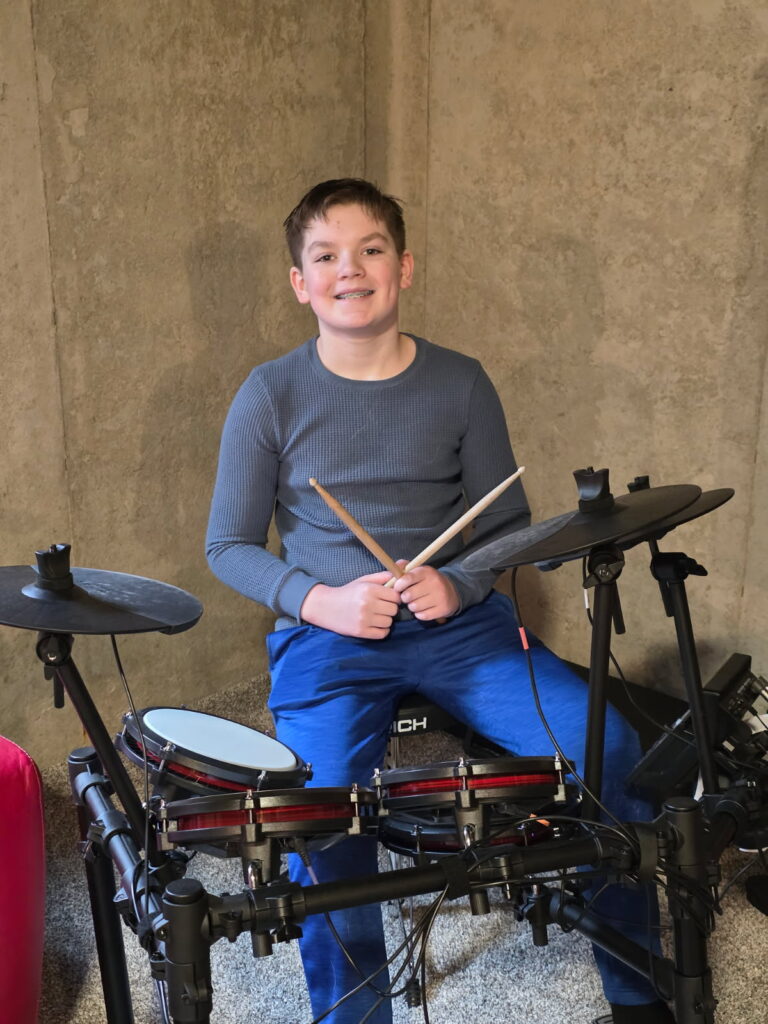
Parker is another example of a student who has worked very hard and has deserved this award for awhile now. His latest accomplishment of learning the drums from Enter Sandman could not be ignored.
More than that, he not only learned the parts but was able to play them live with his instructor. He’s learned to count the beats well but also learn to feel the beats. A great balance of reading and rhythmic talent that gives him lots of potential going forward.
Name: Parker
Instrument: Drums
Time With Us: 13 Months
Favorite Song We’ve Learned So Far: Enter Sandman by Metallica
Dream Song To Learn: Master of Puppets by Metallica
What specific progress or wins are you most proud of so far?: Getting to understand the beat instead of going too fast or too slow based on the music notes.
Next Recital Announcement
The next round of live performances are coming up. The official date is May 16th.
We’ll be announcing more details in the coming weeks. Check your inboxes and ask your teachers for more official information.

Alex's Cool Music Gear of the Month: Drill-Powered String Winder
Changing strings is one of those skills that separates casual players from confident musicians. At Milwaukee Music Lessons, we want students to understand their instrument — not just play it. That includes knowing how to care for it. This month’s cool gear highlight is simple, practical, and surprisingly fun: the drill-powered string winder.
Most beginner guitar students learn to change strings using a small plastic hand winder. It works — but it takes time. A drill-powered string winder attaches to a standard drill and spins tuning pegs quickly and smoothly. What used to take 15–20 minutes can now take just a few minutes. For kids especially, that speed matters. It keeps the process from feeling frustrating and turns it into something empowering.
Why does this matter? Fresh strings sound brighter, stay in tune better, and make practicing more enjoyable. When students hear the difference, they connect effort to results. That builds ownership. It also gives parents peace of mind knowing their child’s instrument is being cared for the right way. We often teach students how to change their strings properly so they feel confident doing it at home — with supervision when needed.
This tool is not flashy. It will not make you play faster overnight. But it supports consistency. It removes friction. And at Milwaukee Music Lessons, we believe consistency matters more than talent. When students feel capable of maintaining their instrument, they practice more. When they practice more, they improve. Small habits like this create long-term progress — and that is what we care about most.
If your child’s guitar has been sounding dull lately, this might be the perfect month to learn how to change strings the right way. Ask us during your next lesson — we are happy to walk you through it.

Guitar Spotlight: Chord Changes That Don’t Break the Song
One of the biggest struggles for guitar players is changing chords without stopping the music. You may know the chords, but when it is time to switch, everything falls apart. Smooth chord changes are what keep a song flowing instead of sounding choppy.
For beginners, the goal is simple transitions between open chords. Moving from G to C or C to D slowly and cleanly is more important than playing fast. Keep your fingers close to the strings as you switch. Do not lift your whole hand far away. Practice moving between just two chords over and over until the change feels calm and controlled.
As you improve, chord changes need to stay smooth at a steady tempo. Try strumming slowly and counting out loud while you switch. If the beat stops, slow down. The song should keep moving, even if you are not perfect yet. Keeping time is more important than landing every note instantly.
At the intermediate level, bar chords add a new challenge. They require more strength and better finger placement. Economy of motion becomes very important. This means moving only what needs to move. Watch for fingers that can stay planted as guides. Smaller movements make faster, cleaner transitions.
When you practice, start slower than you think you need to. Focus on relaxed hands and clean sound. Speed will grow naturally when your movements are efficient. Smooth chord changes keep the song alive, and mastering them will make you sound more confident every time you play.

Piano Spotlight: Reading Music Without Panic
Many piano students feel nervous when they see a full page of notes. All the lines and spaces can look overwhelming. The truth is that reading music is not about memorizing every note at once. It is about learning how to find your place and move step by step.
For beginners, start with landmark notes. Middle C is a great home base. Treble G and bass F are also helpful guideposts. When you know where these notes live on the staff and on the keyboard, everything feels less scary. Instead of guessing every note, you find one you know and build from there.
Next comes simple intervals. Instead of reading each note one at a time, notice if the notes move up, down, or stay the same. If a note steps up from C, it moves to D. If it skips, it might move from C to E. Reading by steps and skips is much faster than reading letter by letter.
At the intermediate level, pattern recognition becomes the key. Chords often look like stacked notes. Scales look like smooth lines moving up or down. Your brain starts to recognize shapes instead of single notes. Sight-reading also improves when you keep your eyes slightly ahead of your hands, like reading words in a sentence.
When practicing reading, go slower than you think you should. Keep your hands steady and do not stop for every mistake. Stay calm and keep the beat moving. Reading music without panic takes patience, but once it clicks, you gain freedom and confidence at the piano.

Drum Spotlight: The Role of Each Limb
Drums are different from most instruments because each limb has its own job. Your hands and feet must work together, but they do not always play the same thing. At first, this can feel confusing. Over time, it becomes one of the most powerful parts of drumming.
For beginners, the focus is basic coordination between the kick, snare, and hi-hat. A simple rock beat is a great place to start. The kick plays on beats one and three. The snare plays on two and four. The hi-hat keeps steady notes in between. Each limb has a clear role. When those roles stay steady, the beat feels strong and dependable.
As drummers improve, the limbs begin to separate more. The hi-hat may keep steady eighth notes while the kick adds extra notes. The snare still lands on two and four, but the timing must stay locked in. This is where independence starts to grow. Each limb learns to do its job without copying the others.
At the intermediate level, ghost notes add another layer. These are soft snare hits placed between the main beats. They are quiet but important. Ghost notes make grooves feel deeper and more musical. They require control, because one hand must play strong backbeats while also adding light touches in between.
When practicing, slow everything down and build one limb at a time. Make sure each part feels steady before adding more. Drumming becomes powerful when every limb understands its role. With patience and consistency, coordination turns into confidence, and confidence turns into groove.

Vocal Spotlight: Pitch Accuracy Without Overthinking
Many singers worry about being “on pitch.” The more they worry, the tighter they get. Pitch accuracy is not about overthinking every note. It is about listening well and responding calmly. When the body is relaxed, the voice usually finds the right place.
For beginners, pitch starts with simple matching. Play one note on a piano and try to sing that exact note back. If it feels off, adjust gently instead of forcing it. Think of tuning a radio slowly until the signal is clear. Small changes are better than big jumps.
As singers grow, they begin to notice how notes move. If a melody goes up from C to D, it should feel like a small step higher. If it jumps from C to G, it feels bigger. This is interval awareness. Understanding the distance between notes helps the voice move with more control instead of guessing.
At the intermediate level, melodic control becomes more natural. You can start a phrase confidently, land higher notes without sliding, and return to lower notes smoothly. Instead of chasing pitch, you guide it. Listening carefully before and during each phrase keeps everything steady.
When practicing, slow down and stay relaxed. Sing short patterns and repeat them until they feel comfortable. Record yourself and listen without judgment. Pitch improves through steady, calm practice. With time and patience, accuracy becomes less about thinking and more about trusting your ear.

General Music: What “Good Practice” Actually Means
Many students think good practice means playing for a long time. That is not always true. Good practice is not about how many minutes you sit with your instrument. It is about how focused and consistent you are while you are there.
For beginners, good practice starts with simply showing up. Playing for 10 to 15 focused minutes several times a week is more powerful than one long session once in a while. Consistency builds habits. Habits build skill. Even reviewing one chord, one scale, or one short section of a song counts as real progress.
As students grow, practice needs direction. Instead of just playing songs from start to finish, break them into small parts. Work on the hard measure. Slow it down. Fix one mistake at a time. This turns practice from repeating errors into solving problems.
At the intermediate level, practice becomes goal-driven. Each session should have a clear purpose. Maybe the goal is smoother chord changes, cleaner rhythm, or stronger breath control. When you know what you are working on, improvement becomes easier to see. Random practice feels busy. Focused practice builds results.
Good practice is steady, intentional, and patient. It is not always exciting, but it always moves you forward. When you focus on consistency and clear goals, progress becomes visible, and music stays rewarding for the long term.
Student Milestones
1 Month
Bawi
Undra
Craig
Naomi
Nolan
Riley
Amy
Dymytrii
Hannah
Sarah
3 Months
Lauren
Charlie
6 Months
Maddison
Ava
Ethan
Josh
Bailey
Loki
Ralph
Max
Josiah
Mlakai
Danny
Charlie
Joey
Ethan
Emily
Lucy
Fina
Allison
Willow
Morgan
Lauren
Paislee
Kaitlyn
Autumn
Owen
Adam
Oliver
Leah
Claire
Winston
9 Months
Kenny
Michael
Marty
Phil
Judah
Eli
1 Year
Jeremy
18 Months
Anabelle
Garrett
Nolen
Kai
Abraham
Kate
2 Years
Matt
30 Months
Luke
Caleb
Andrew
More News